Category: Blog

Blog posts from The Unite group.

Here at the Unite Group, we like to keep our clients and network up to date with the information that can help them in their business using our blog pages.

We cover topics such as IT support, Hosted telephony, Cyber security, Digital marketing, and much more. We think it is important to educate our audience using our blog, not only on these topics but to give a behind-the-scenes view on what is going on day to day at the Unite Group and the people who make up our team. Having knowledge of what we offer can help you to make a more informed choice on the services you need and which ones would work best for your business.

If there are topics you would like to see us create content around then drop us an email and we will get these added for you.

  • How to Avoid These 5 Common Cloud Migration Challenges

    How to Avoid These 5 Common Cloud Migration Challenges

    one drive v sharepoint
    Cloud Migration Challenges

    Cloud migration is essential for businesses pursuing a digital transformation – allowing you to scale your resources and better manage your digital infrastructure.

    However, in order to fully utilize cloud computing, businesses still have a lot of hurdles to overcome. A bad migration strategy could, at best, slow your processes down. At worst, you risk irreversible data loss or opening your business up to security vulnerabilities. 

    Getting your cloud migration strategy right can be difficult. But, if you avoid these five common challenges, you can dramatically speed up the process and ensure a successful migration! Managed service providers (MSPs) can handle this responsibility for you, easing your workload and ensuring a smooth transition.

    In this article, you’ll learn why you should migrate to the cloud and how to ensure a successful migration!

    Why do businesses migrate to the cloud?

    In the modern business landscape, there’s no space for ineffective, slow infrastructure that cannot rapidly scale with your business and its changing demands.  The cloud is replacing legacy, on-premises technology with flexible, scalable, and cost-effective computing power around the world.

    Here are the most important benefits of cloud migration: 

    • Better scalability: Resources and capacity can be scaled up or down depending on your demand/traffic.
    • Improved performance: Cloud service providers offer powerful hardware and lightning-fast network connections. 
    • Cost savings: By adjusting resources on the fly, organisations can eliminate unnecessary assets and reduce the equipment needed. 
    • Improved digital experience: Consumers demand omnichannel user experiences. Cloud services help you build more responsive applications that use interconnected services to improve your user experience. 

    What are the common challenges faced during a cloud migration? 

    Businesses lack a comprehensive cloud migration plan

    Cloud migration is an involved & delicate process. Unfortunately, many businesses fail to develop a comprehensive strategy for dealing with this transition – and instead prefer to adopt the so-called “lift and shift” strategy. 

    In reality, on-premise applications and services may not be ready, out-of-the-box, to be cloud-native. Migrating these workloads onto cloud servers may lead to compatibility issues, slowdowns or even data loss. 

    The solution to this challenge is simple: make sure you have developed a succinct plan before pulling the trigger. 

    Any cloud migration strategy should: 

    • Take into account thebusiness valueof moving to the cloud. What areas of the business would benefit the most from migration? 
    • Examine which applications and workflows best translate to a cloud-based environment. Some processes may migrate perfectly. Others may not. A plan should outline cloud-native replacements – such as Microsoft 365 apps. 
    • What timeline should your migration follow? Which applications should be migrated first? 

    Not modernising services & workflows for the cloud

    As we mentioned prior, not all applications and services are best suited for the cloud. In fact, cloud-native services can look very different to their on-premise counterparts. 

    How? Cloud services benefit from a modular software architecture – such as microservices. Monolithic applications limit your ability to customize frontend experiences.

    Some workloads aren’t designed to take advantage of your cloud resources – whereas older applications may be quite resource-inefficient. 

    There are two approaches to modernising workflows:

    • Tinker with applications to make them more cloud friendly. Some applications may need to be refreshed to ensure compatibility.
    • Replace workflows with cloud-native platforms.

    Data Security and Compliance Risks

    Cloud migration presents many preventable risks for data loss and leakage. Many businesses are hesitant to migrate to the cloud due to these concerns – with 56% citing security as a considerable concern

    A large part of this perceived risk is handing data to third-party companies in the form of cloud vendors. Intuitively, this makes sense – wouldn’t on-premise solutions provide better security? 

    In reality, cloud providers take security and compliance very seriously – and have numerous safeguards in place to protect your data. 

    In many cases, it’s actually easier for criminals to breach your on-premises servers than launching an attack on a cloud service provider like Azure, AWS or Google Cloud. 

    Moreover, cloud services have tools to automate compliance procedures and ensure tight access permissions to minimise insider threats. 

    So, is the cloud migration process risk-free? No. The major threat is indeed in the migration phase – as any of your data may be intercepted if your migration process is insecure.

    How can we avoid this? An MSP will check your migration procedure before you go ahead and ensure that your sensitive data is protected from attackers and that you have data redundancies in place to prevent loss. 

    Lack of in-house expertise

    Cloud migration is more complicated than you might think. Sure, vendors have developed intuitive migration tools to simplify the process such as Azure Migrate

    But, if anything does go wrong, your in-house IT staff may lack the expertise to quickly and effectively troubleshoot. The risks of this should be fairly evident: operational downtime and potential data loss! 

    Luckily, the solution is simple. Outsourcing to MSPs is the best way to ensure your migration process is handled by technicians with the correct level of expertise for the job. 

    Trust us, cloud migration isn’t a process you should ‘wing’ and hope for the best!

    Unexpected migration costs

    In order to save costs, many companies prefer to migrate on their own. However, this can end up costing more in the long run. 

    What are some hidden costs associated with the migration procedure? 

    • The most pressing is the cost of operational downtime and its impact on productivity. You’re likely to spend more time troubleshooting and configuring your cloud platform without a migration partner. 
      • Moreover, an MSP can train you and your staff on how to get the most out of your cloud services from day one. 
    • Lack of data recovery solutions and data redundancy. If anything goes wrong with your migration process, you may lose important data. MSPs operate with a strict data hygiene approach and will always insist on backing up important information. Lost data is very expensive to recover.
    • Compatibility issues will present further challenges post-migration. These contribute to lost productivity, but incompatible software will still have to be altered or replaced – presenting another cost.  

    That’s why working with a consultant at an MSP is so important. They can better develop your migration strategy and budget more effectively to bring down your total cost of ownership (TCO). 

    Avoiding the above challenges, and the rest you may face, can help avoid these unexpected costs. Tapping into the expertise of migration professionals can help boost your ROI. 

    Let’s get your cloud migration right!

    The theme is clear. Challenges can be avoided by working with a cloud migration partner. Costs can be minimised by developing a comprehensive and realistic migration strategy and following that to the tee. 

    By utilising the expertise of an MSP, you will be able to eliminate compatibility issues and data security risks, thereby ensuring a successful migration.

    Ready to embark on your digital transformation and migrate to the cloud? Get in touch with us today to see how we can help! 

  • August 2022 – Newsletter

    August 2022 – Newsletter

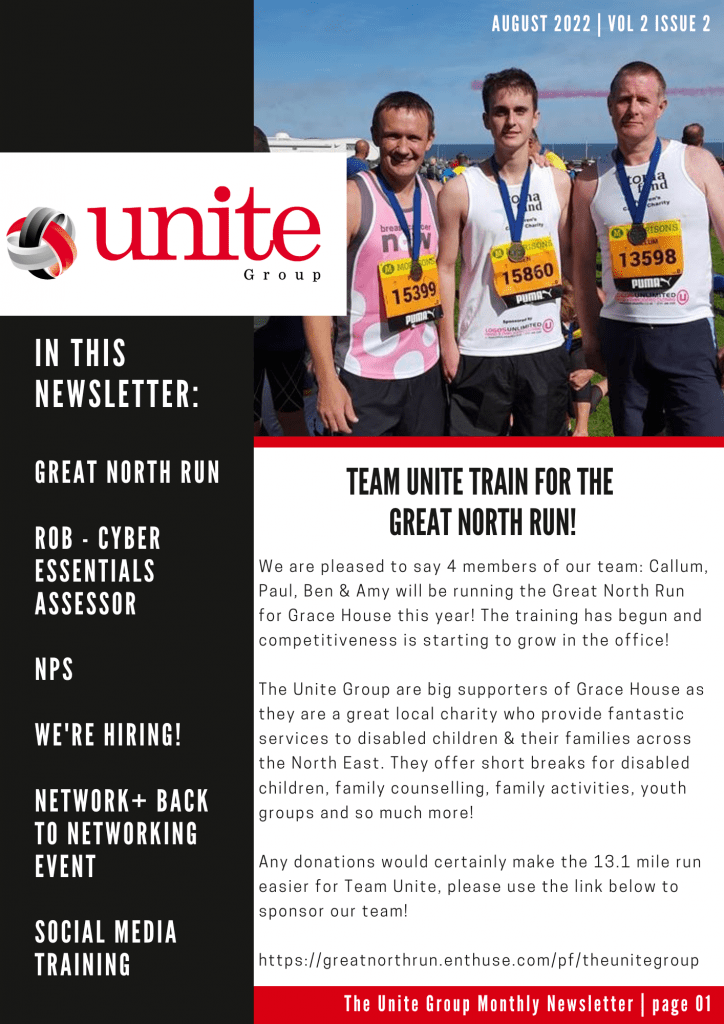
    It’s that time of the month again! Our newsletter has arrived! Here at The Unite Group we love to keep our customers up to date with the latest deals, tips, industry news as well as what our fantastic team are getting up to! Read our August issue to see what we have got up to in the past month!

    In this newsletter: We wish good luck to Team Unite taking on the Great North Run, we congratulate Rob for qualifying as a Cyber Essentials Assessor, we share a client spotlight on NPS, prepare for the next Network+ event & share how our Social+ team can take your digital marketing to new heights!

    To read The Unite Group’s August Monthly Newsletter, click on the image below!

    To be added to our mailing list drop us an email, info@theunitegroup.co.uk or to speak to our friendly team call us on, 0191 466 1050

  • What is Cyber Essentials Certification and why should you get it?

    What is Cyber Essentials Certification and why should you get it?

    about cyber essentials
    We answer your questions about Cyber Essentials!

    You keep hearing the term cyber essentials, but what exactly does it mean? Why should your business consider being a part of the scheme? With cyber-attacks becoming ever more common, there is no better time to understand the steps you can take to protect your business from the most basic attacks. Many cyber-attacks are carried out by low skilled individuals. So taking some basic steps can massively reduce the chance of you falling victim to one! Here at The Unite Group as your trusted technology provider we want to best advise our customers on how to protect themselves as well as their customer data. In this blog, we will explain to you the basics of Cyber Essentials. As well as how we can help & guide you through achieving the certification.

    What is Cyber Essentials?

    Cyber Essentials is a Government-backed and industry-supported scheme that allows businesses to protect themselves from cyber-attacks. The scheme lays out a clear statement of the basic cybersecurity measures an organisation should have in place to protect themselves from the growing threat of attacks.

    Cyber essentials is a foundation level certification. This was created to provide the basic controls an organisations should have in place to reduce the risk of common cyber threats. This first step protects you from 80% of the most basic cyber security breaches.

    Upon completion, organisations can then move onto Cyber Essentials Plus. This is the highest level of certification offered in the scheme, so this includes a more rigorous test of an organisations Cyber Security systems. Experts carry out vulnerability tests and ensure organisations are well protected against basic hacking and phishing attacks.

    What does the certification process include?

    Obtaining The Cyber Essentials certification is a relatively simple process

    1. Choose The Unite Group as your Provider
    2. Complete your self-assessment questionnaire and then await its review.
    3. Once your submission is approved, you will then receive your certificate.

    If for any reason you have any issues, Unite will be here to support you through the process.

    Who runs Cyber Essentials?

    It was developed and is operated by NCSC (the National Cyber Security Centre). It is the UK Government’s answer to a safer internet space for all organisations of all sizes.

    Is Cyber Essentials UK only?

    Although it was developed by the UK’s National Cyber Security Centre, it is globally recognised as a certification that enhances an organisations protection against data breaches and leaks. Therfore, organisations with global customers can complete this certification and be confident it will be recognised internationally.

    Why should you get Cyber Essentials?

    Having certification allows businesses to show you can trust them and take their security seriously when it comes to cyber security. This can open new opportunities as a lot of larger organisations will only work with companies who can demonstrate their cyber security protection measures. Many Government contracts require certification to be considered.

    However, the benefits are not only external. Internally the scheme provides a clear picture of your organisations cyber security level. You can feel confident you have taken the necessary steps to protect your businesses. Therefore eliminating some of the risk of your organisation experiencing an attack.

    Can you afford not to have certification? Are you ready to protect not only your organisation but the data of your customers by doing the Cyber Essentials certification?

    How can we support you through the process?

    Here at The Unite Group, we can provide support to you throughout the process. Unite are an authorised certificate issuing body for Cyber Essentials. As a result we can manage the entire process for you from initial audit, remedial works and certificate issue.

    Do you want peace of mind that your defences will protect you from a large amount of the most common cyber-attacks? Contact us today and our friendly, knowledgeable team will be happy to explain in more detail the Cyber Essentials certification process or help you take the first steps to achieving your Cyber Essentials Certification!

  • A chat with Rob, one of our Senior Service Engineers

    A chat with Rob, one of our Senior Service Engineers

    rob MTT
    Rob, one of our Senior Service Engineers

    Continuing on with introducing you to the team that make up The Unite Group. Next up we introduce Rob. We recently had a chat with Rob about his role…

    Growing up, what did you want to be?

    I always knew I would work in something Technology related, my family on my fathers side have been engineers or similar going back at least five generations. For about a decade I thought I would likely work in the AV field, and did a fair amount of work doing lighting or sound, starting at a youth theatre, and continuing into working in bars and clubs.

    What is your role at The Unite Group and how did you end up where you are now?

    At The Unite Group I am a Senior Service Engineer. In my role, I mostly work on projects. I started with Unite as an Apprentice, shadowing another engineer for a bit, and then working on the Helpdesk. Since then as the company has grown I have completed various qualifications to get to my role within the company.

    What does a typical day look like at The Unite Group?

    Most days start with checking the health of a few services that I manage. I’ll run though any alerts that have been generated overnight, I’ll then create support tickets for anything that requires further looking into. I also run a few health tests on demo networks that we have at the office.

    From there I then move onto emails. After which it really changes on a day to day basis. I mostly work on projects and installs now. So off to client sites for installs, or planning work.

    What is your most and least favourite part of the job?

    My favourite part of the job has got to be the process of taking apart and re-building a system to trace down a particular fault. I’ll normally do this when there is an actual ongoing issue that needs resolved, but this can also be done when we’re onboarding a new client with limited documentation, to make sure that we can fully understand any issues that might come up.

    My least favourite part of my job would be all the paperwork around the jobs. When I worked at the NHS many years ago, one of the medical leads often said “midwife means with wife, not with computer” and I can now relate.

    What is your greatest achievement?

    I’m very happy how I left a small theatre I volunteered at. When I started, the entire society had a budget of around £300, and about 5 working lights. It was always a fun challenge to get a production on with what we had available.

    Over the next 4 years myself, and a new committee managed to improve the situation somewhat. I took over as head of the technical side of the theatre, and managed to build up that side of things, training up new technicians, and managing shows on a weekly basis.

    By the time I left the society had working lights, sound system, and a budget plan for fixes and replacement going out for a decade.

    What is the best piece of advice you’ve been given?

    If you can’t explain it you don’t understand it. I always try to understand something well enough to be able to explain it simply to someone else. Often this is reduced to explain to a five year old, which while entertaining may take quite a long time.

    Where do you see yourself in 10 years’ time?

    In 10 years time, I can see my role getting a bit more specialised within The Unite Group. I’ve already started working on some more niche things and I hope to grow into more of these. One of the areas I am currently expanding my knowledge into is Cyber Essentials. I am looking forward to seeing where this takes my role within The Unite Group. As well as what opportunities it will offer to our customers to protect their organisations further against possible cyber attacks.

    How do you unwind outside of work?

    When left to my own devices there is nothing nicer than a glass of whisky and a good book.

    Want to learn more about how Rob and The Unite Group can help you with your business technology needs, contact us on, 0191 466 1050.

  • 5 Common Cybersecurity Myths Your Business Should Be Aware Of

    5 Common Cybersecurity Myths Your Business Should Be Aware Of

    cybersecurity myths
    Are you aware of the top cybersecurity myths?

    What are the top cybersecurity myths you should be aware of in 2022? In this article, we’ll debunk some of the biggest misconceptions about digital security.

    Thankfully, businesses are now more aware than ever of cyber threats and are starting to take cybersecurity very seriously. PwC found that nearly 64% of UK CEOs are concerned about how cyber threats could harm their ability to sell products and services.

    Indeed, taking into proper account your organisation’s cybersecurity is a vital part of running a modern business. This keen focus on abating cyber threats, however, had led to many cybersecurity myths becoming commonplace.

    Believing these ill-informed cybersecurity myths could leave your business vulnerable to threats and may render your security infrastructure ineffectively. 

    Myth 1: Hackers don’t target small businesses

    We understand why some small business owners feel like cybersecurity isn’t important to them. Cybersecurity can be a big investment for smaller firms and start-ups and many decision-makers would prefer to spend that money on other sections of the business.

    However, there’s no truth in the misconception that hackers don’t target small businesses. In fact, a report from Barracuda found that cybercriminals are up to three times more likely to target small businesses than larger firms. 

    Why? Hackers smaller businesses as ‘low-hanging fruit’ and target their inadequate security infrastructure and take advantage of insufficient security training for staff for social engineering attacks.  

    Furthermore, the lasting damage of cyber attacks to smaller businesses is greater than for enterprises. 60% of small businesses fail within six months of a cyber attack or data breach. 

    Myth 2: Antivirus and firewalls will protect my business

    Firewalls and antivirus software are a brilliant first line of defence for your digital infrastructure – but attacks can and will get through them. A holistic cybersecurity strategy will need to use other methods of protection such as backups, cybersecurity awareness training and two-factor authentication. 

    First of all, antivirus software and firewalls are only effective if they’re regularly updated and configured correctly. Not quite sure how to make sure they’re running effectively? We recommend working with a Managed Service Provider (MSP) like ours to configure your security infrastructure for you.

    Secondly, antiviruses and firewalls can only protect your business from malicious software and intrusions. They’re less effective at preventing social engineering attacks such as phishing scams, mishandled login credentials or internal threats. We’ll cover what’s needed to prevent these attacks later on!

    Myth 3: Phishing attacks are easy to spot

    A common misconception is that only the tech-illiterate fall for phishing attacks and that cyber awareness training is a waste of time for those who are “good with computers.”

    In reality, this just isn’t the case. Phishing attacks – especially those specifically targeting your business for espionage – are becoming increasingly more convincing. 

    One of the most common forms of phishing is a spear phishing attack – where attackers use gathered intel about your business to make the email (or phone call) look legitimate. Over 65% of targeted attacks are done this way. 

    They commonly ask for payment or urgent action for a convincing reason. Attacks may also spoof a legitimate email – for example, a manager, the CFO or CEO. 

    Businesses need to train their staff on spotting phishing attacks and what sorts of emails to be suspicious about. However, even then, some phishing attacks may be too convincing to spot. For that reason, you’ll also need an email filter actively looking for possible phishing scams.

    Myth 4: A long complex password will keep my account safe

    A strong password policy is a cornerstone of a cybersecurity strategy. However, there are some other considerations to make other than having a long, complex password: 

    • Enforce a policy to regularly change passwords. Some hackers may gain login credentials through phishing or a data breach. Changing passwords regularly removes this opportunity. 
    • Encourage employees to remember passwords and not write them down. What’s the point of a complex password if it’s available for everyone to see on a post-it note or a text file?
    • Your employees should never share their passwords – even with trusted colleagues, friends and family. 
    • Implement multifactor authentication to ensure that hackers can’t gain access to your employees’ accounts even if they have their passwords.

    Myth 5: The only real concern is external threats

    Insider threats pose just as much of a concern as external threats – if not, more as they’re difficult to protect against. According to Gurugul, 98% of companies are concerned about insider threats whilst only 11% believe they’re well protected from them. 

    Internal threats fall into three broad categories: 

    • Negligent Insider
    • Stolen Credentials
    • Malicious Insider

    Negligent insider threats are when an employee or executive negligently exposes your business to a cyber vulnerability – but unintentionally (or at least without malice). This is is the most common insider threat.

    These types of threats can be prevented through cyber awareness training or a Data Loss Prevention program. 

    Stolen credentials involve the loss of credentials – mainly through social engineering attacks such as phishing. Protecting from these attacks involves awareness training, two-factor authentication and suspicious activity detection. 

    The least common type of insider threat is the malicious insider attack – where an employee or business partner causes damages or steals data intentionally. This is by the hardest to protect from as companies generally assume all their employees aren’t out to sabotage them. 

    The best way to protect from this is by enforcing strict access permissions (and ensuring employees can only access the data they need) and using data loss prevention (DLP) and monitoring tools. 

    These steps prevented a huge data incident in October 2021 when a Pfizer employee uploaded 12,000 confidential files to a Google Drive account – according to Reuters. This suspicious activity was detected and prevented by DLP software. Turns out, the employee had accepted a job offer from competitor Xencor, and this was attempted espionage.

    How we can help secure your business

    Cybersecurity infrastructure is a long, complex process. However, the return on investment (ROI) of cybersecurity projects is immense due to security expenses avoided is immense. 

    For instance, according to IBM’s Cost of a Data Breach Report 2021, the average cost of a data breach is $4.24M! That’s why we highly recommend upgrading your security infrastructure and protecting your business from increasingly dangerous cyberattacks.

    Want to learn how we can help you secure your business? Looking to deliver effective cyber awareness training? Want to explore what software solutions are best for protecting your business? 

    Get in touch with us today and see how we can level up your business’s cybersecurity with Cyber Essentials

  • A chat with Callum, our Operations Director

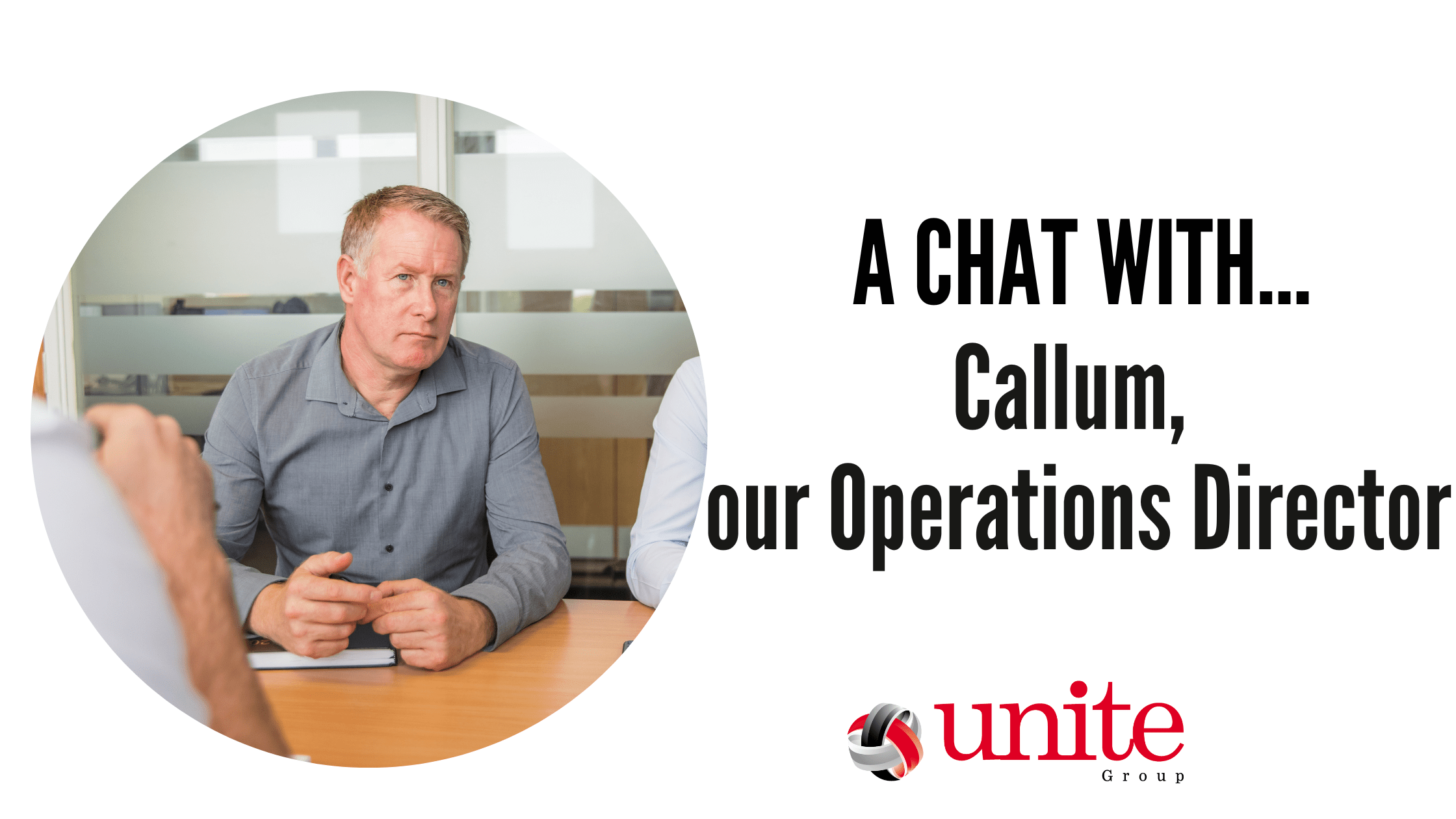
    A chat with Callum, our Operations Director

    callum mtt
    Callum, our Operations Director

    Next up in our meet the team series we introduce Callum, our Operations Manager. We recently had a chat with him to find out a bit more about what he does within the Unite Group…

    Growing up, what did you want to be?

    Growing up, I always wanted to be an astronaut!

    What is your role at The Unite Group and how did you end up where you are now?

    My role here at The Unite Group is as the Operations Director. This role involves managing the help desk, coordinating the projects, employee well-being and technical support on all things telecommunications related. Being at Unite with Paul from the start, I came into this role as the company grew and we gained 2 more directors. This felt the best suitable role for me to really utilise my skillset and experience (I’ve been in this industry for 20 years!)

    What does a typical day look like at The Unite Group?

    My typical day consists of lots of coffee, emails, and coordinating the engineers and helpdesk guys as well as planning projects. So my days are often very busy!

    What is your most and least favourite part of the job?

    My favourite part of the job has got to be seeing projects complete smoothly, it’s always great to see when we are able to help our customers seamlessly. Also seeing customer issues being fixed and getting great feedback about our team is always great!

    My least favourite part of the job however has to be delays due to unforeseen issues and the lack of available hardware to complete work as it is still an ongoing problem. These issues take matters out of our hands and can make it a bit harder for us to fix our customer’s problems. However, here at The Unite Group, we will always do our utmost to ensure our customers are back online and working without any problems as soon as possible.

    What is your greatest achievement?

    My greatest achievement has got to be landing a plane for the first time when learning to fly. I was in the RAF from 1989 through to 2000, I wasn’t a pilot in the RAF I just fancied giving it a go, great fun taking off after getting the go-ahead from the tower, not much happens in the sky but landing is scary and a massive relief once you are down.

    What is the best piece of advice you’ve been given?

    Never give up and stay positive.

    Where do you see yourself in 10 years’ time?

    In 10 years time I’d like to hope I’ll be in the same role but with a reduced working week and more free time to enjoy life and chill out more, might even take up golf!

    How do you unwind outside of work?

    Outside of work, I enjoy socialising with my friends. You can also often find me playing random sports (badly) and listening to music. I love to attend concerts when I can. Currently, outside of work, you will find me training for the Great North Run. I am taking part alongside Paul & Ben raising money for a fantastic local charity Grace House! This will be my 10th time doing the run and I hope to beat Ben (A chat with Ben, one of our Senior Service Engineers) again this year 😊. If you’d like to sponsor us, it would definitely help us make it round, please find our fundraising page here. Cycling the Great North Bike Ride again and also cycling to Edinburgh later this year following the coast and castle and pubs route.

    If you want to see how Callum and The Unite Group can help you with your business technology needs, contact us on, 0191 466 1050.

  • Why a Cyber Essentials certification is important for SMBs

    Why a Cyber Essentials certification is important for SMBs

    cyber essentials certification
    So why should you have cyber essentials certification?

    In recent years, it has become increasingly important for businesses to secure their IT systems to reduce the chance of falling victim to a cyberattack. In the UK alone,39% of businesses were targeted by a cyberattack in the last 12 months. Whilst most cyberattacks target large businesses and enterprises, it is also just as common to happen to small businesses. This is because they are less likely to have invested in securing their IT systems. For this reason, all SMB owners should invest in strengthening their security posture and aim to achieve a Cyber Essentials certification.

    What is a Cyber Essentials certification?

    It is a UK Government backed scheme that is designed to protect companies against a wide range of cyberattacks. There are two levels of certifications: Cyber Essentials and Cyber Essentials Plus. Cyber Essentials is a self-assessment, that ensures businesses have controls in place to protect against most common cyberattacks. Cyber Essentials Plus is a more in-depth certification and includes hands-on technical verification.

    The certification covers many areas, including firewalls, secure configuration, user access control, malware protection, security update management and more. The Cyber Essentials certification lasts for 12 months. It is then regularly updated to make sure businesses are protected against basic attacks.

    The importance of cybersecurity for SMBs in 2022

    All small businesses are at risk of falling victim to a cyberattack. The most common cyberattacks being phishing, data breaches and ransomware attacks. All of these attacks can be awful for businesses, both in terms of the costs, as well as the costs associated with damages to a business’s reputation.

    Thankfully, many of these attacks are carried out by relatively unskilled cybercriminals. So fortunately they can be stopped by implementing some basic security controls. In a recent blog we explained the benefits and added protection of companies outsourcing their cybersecurity to professionals. With a Cyber Essentials certification, these attacks are no longer viable.

    Benefits of a Cyber Essentials certification for SMBs

    Reduce the chance of falling victim to a cyberattack

    The overall goal of Cyber Essentials is to reduce a business’s cyber risk. As the assessment covers most attack surfaces and the associated technical security controls, Cyber Essentials covers all the bases to protect from 80% of common cyberattacks. Although the methods that cybercriminals use are constantly changing, these technical controls will typically stop basic attack methods, especially if they are not highly targeted attacks.

    Gain a competitive advantage

    For small businesses within competitive industries, a Cyber Essentials certification can be a way to stand apart from the competition. The certification shows that your business takes security seriously. Therefore any customer, either consumer or corporate, doing business with you is less likely to have their data leaked as part of a customer data breach. After a business obtains their certification, they can also display the certification badge on their website and other marketing materials.

    Find new business opportunities

    A Cyber Essentials certification is mandatory for businesses considering submitting a bid for a contract with the NHS, Ministry of Defence, and UK Government. Many private sector businesses also look for the Cyber Essentials badge of approval when seeking new suppliers.

    Improve credibility and reputation

    The technical controls necessary to obtain the certification are relatively simple to implement, and the self-assessment is a quick and easy process. This simple and affordable option can add significant value to a business as it improves credibility and reputation. Having a Cyber Essentials certificate shows customers that a company is committed to protecting its data. It also shows they are taking action to reduce the chance of them falling victim to a cyberattack.

    Free Cyber Liability Insurance

    Once your business has gained its Cyber Essentials certification, your business is automatically entitled to free Cyber Liability Insurance to the total limit of £25,000 of indemnity. This also gives businesses access to a 24-hour hotline to report a cyber incident. This includes crisis management and incident response. For businesses that do not already have cyber insurance, this is a perfect option to recover from a small breach or incident. Many cyber insurance providers will also give discounts to businesses that are certified.

    How we can help?

    For businesses that are’t well versed in the world of cybersecurity, it can be difficult to implement the technical controls necessary to obtain a Cyber Essentials certification. We can help your business implement the technical controls. As well as this we provide additional security services to further reduce the chance of falling victim to a cyberattack. To find out more, contact us today.

  • A chat with Ben, one of our Senior Service Engineers

    A chat with Ben, one of our Senior Service Engineers

    One of our Senior Service Engineers Ben, standing next to one of our company vans.
    Ben, one of our Senior Service Engineers

    Next up in our meet the team series we introduce Ben, one of our Senior Service Engineers. Ben has been with us from starting as an apprentice and is an extremely valued member of our team. We recently had a chat with him…

    Growing up, what did you want to be?

    I never really knew what I wanted to be when I grew up. I realised in 6th form that I wanted to look to work in a trade. So I spent time researching which industry I wanted to work in. That’s when the opportunity to do my apprenticeship with Unite came up it seemed the perfect route.

    What is your role at The Unite Group and how did you end up where you are now?

    I am a Senior Technician at The Unite Group. Starting at Unite as an apprentice, Unite provided me with all the training and support to get me to where I am now. I was lucky to join the business very early on which has given me a lot of experience in the industry. This has also allowed me to be a big part of the growth in the company.

    What does a typical day look like at The Unite Group?

    There isn’t a typical day, every day brings different experiences and challenges. My time is split between working in the office, supporting the guys on the helpdesk, working on projects, and attending customer sites. When I attend site visits this can often include installing equipment or troubleshooting faults that have been raised to us.

    What is your most and least favourite part of the job?

    I really enjoy getting out and meeting our customers. It’s great that we get to work with such a wide variety of businesses which makes no day the same. We have a great team in the office which makes coming to work so much easier! I know there will always be plenty of support and laughs.

    I think I would say my least favourite is this! The marketing team loves to get us involved in the social media content and let’s just say it’s not my strongest point.

    What is your greatest achievement?

    It’s hard to pick a greatest achievement but I am most proud of what I have achieved in my career. Over the past 11 years working at The Unite Group I have accomplished so much to progress my career. Working hard to complete training over the years and putting the time in to now have the expertise I do in the industry, is one of my greatest achievements.

    I have also completed the Great North Run. 3 times actually over the years with my 4th one coming up this September. As of yet, I have been unable to beat the time of Directors Paul and Callum (both over 50)! So although this is an achievement, I still feel I can train harder to finally get to the finish line before them!

    What is the best piece of advice you’ve been given?

    Whatever you do give it 100%.

    It is easy to be complacent in things but if you know everything you are doing you have given it 100% then you can look back and wonder what if.

    What do you like to do outside of work?

    Eating, drinking, and football probably about sums it up. I am a Newcastle United fan so it’s not been easy to support them the past couple of years, but better times are coming. I also play 5 a side football when I can to try and keep fit and this year will be running the Great North Run for Grace House, find my sponsor page here.

    Where do you see yourself in 10 years time?

    I enjoy my role here at The Unite Group and the company has provided me with progression throughout my career right from being an apprentice to a senior service engineer. As our company is growing I can see my role changing in the future and I will continue to work hard in order to make the most of my career and continue to be a part of the company striving forward.

    If you want to see how The Unite Group can help you with your business technology needs, contact us on, 0191 466 1050.

  • July 2022 – Newsletter

    July 2022 – Newsletter

    Here at The Unite Group we are always looking for ways to keep our customers up to date with the latest deals, tips, industry news as well as what our fantastic team are getting up to! We are proud to produce a monthly newsletter to do this.

    In this newsletter: we share the charity golf days we are participating in, celebrate 1 year of our newsletter, welcome 2 new team members to the Social+ team, showcase one of our fantastic customers Tumble Activity Centre, introduce the next Network+ event, talk all things cyber essentials & are looking for an individual to join our team!

    To read The Unite Group’s July Monthly Newsletter, click on the image below!

    To be added to our mailing list drop us an email, info@theunitegroup.co.uk or to speak to our friendly team call us on, 0191 466 1050

    July newsletter
    July 2022 Newsletter
  • Cybersecurity – 5 reasons why your business should outsource it

    Cybersecurity – 5 reasons why your business should outsource it

    Cybersecurity with The Unite Group

    Maintaining a strong cybersecurity posture is a significant challenge for most businesses. With complex cyberattacks becoming more common, all businesses are at risk of falling victim. To reduce this risk, businesses typically implement new technologies that focus on prevention, detection, and remediation.

    However, this technology alone will not prevent a cyberattack, it will need to be supported by skilled security professionals. Many businesses choose to outsource this to a trusted third party to ensure their business is as safe as possible. In this article, we will discuss 5 reasons why businesses should outsource their cybersecurity.

    Access to experienced professionals

    Many businesses rely on their in-house IT teams to manage their infrastructure, as well as their cybersecurity. Depending on the size of the company, and the workload of the IT department, this can be an overwhelming task. This can then result in a poor security posture and an overworked team. This is made harder as there is a cybersecurity skills shortage. This makes it difficult for businesses to employ experienced cybersecurity professionals.

    When a business outsources their cybersecurity to a trusted third party, they gain access to a team of cybersecurity specialists. Their experience ensures they will be able accurately find and plug gaps within a business’s security posture. And most importantly they are aware of the current cyberthreats, and the best way to avoid them.

    Reduce costs

    For businesses of all sizes, employing a new security professional or training an existing employee can be extremely expensive. For smaller businesses, it can sometimes be difficult to justify having an employee that is dedicated solely to security. In addition to the cost of employing or training someone, a business will still need to pay for cybersecurity technologies.

    Whereas if a business outsources its cybersecurity, the cost is typically a fixed amount per month. This includes the technology, as well as access to the team of cybersecurity professionals. Whenever a business is considering the cost of outsourcing security, they should also consider the average cost of a cyberattack. Looking at the cost to the business if this was to happen can help estimate the return on investment.

    Decrease workload for in-house IT teams

    If your business has an in-house IT department, it is highly likely they already have a full workload maintaining the IT and assisting with support requests. This often leaves them with insufficient time to work on the perfect security solution, or threat monitoring.

    With outsourced cybersecurity, the third-party provider is responsible for the planning, implementation and monitoring of a cybersecurity solution. This gives in-house IT departments more time to spend providing IT systems that help grow the business and provide better experiences for other employees and customers.

    Improved incident response time

    After a business falls victim to an attack, it is imperative that they respond quickly to reduce further damage and limit downtime. If a cybercriminal enters a network or system during the weekend, an in-house IT team may not notice until Monday morning. This will give the threat actor enough time to move laterally across a network and inflict even more damage. For example, it only takes 18 minutes for Russian nation-state hackers to move across a network.

    Many cybersecurity providers offer 24/7 protection, detection and remediation to ensure that regardless of when an attack occurs, there is someone ready to swiftly take action. This is also a more cost-effective method of around the clock protection, as it would be extremely expensive to hire an internal team to work throughout the nights and on weekends.

    Access to advanced technologies

    There are many cybersecurity technologies out there which are designed to fulfil specific roles, including endpoint protection, email protection, autonomous detection, and many more. For an in-house IT department, they will not have experience with all of these advanced technologies, and it would be too costly and time-consuming to provide training for all solutions.

    If a business chooses to outsources their cybersecurity requirements, they will be protected by a team of professionals that have experience in the cybersecurity technology. As this team live and breathes cybersecurity, they will also be able to accurately provide insights into which technologies are worth a business investing in.

    Looking to outsource your cybersecurity?

    In 2022, all businesses need to invest in cybersecurity, before it is too late. There are many advanced threats out there that most in-house IT departments are not prepared or able to defend against. For this reason, it is logical for businesses to outsource their cybersecurity to a trusted third-party provider. To find out more about how we can keep your business safe, contact us today.